
Table of contents
- Progress of Hyderabad Smart City Projects in 2026 Under the Smart Cities Mission
- Smart Cities Mission Framework and Telangana Implementation
- Hyderabad’s Smart Infrastructure Investments
- Surveillance, Traffic Management and Digital Infrastructure
- Multimodal Connectivity and Growth Corridors
- Telangana’s Future City Project – A Net-Zero Urban Model
- Emerging Developments – AI City and 15-Minute City Model
- Challenges and Implementation Outlook
Progress of Hyderabad Smart City Projects in 2026 Under the Smart Cities Mission
Hyderabad: Smart infrastructure development in the city continues to accelerate through a combination of national Smart Cities Mission initiatives and Telangana’s large-scale Future City blueprint. As of early 2026, most smart infrastructure components are operational, with major long-term expansion planned toward 2047.
Smart Cities Mission Framework and Telangana Implementation
Launched in 2015, the Smart Cities Mission aimed to modernize 100 Indian cities through area-based development and technology integration.
In Telangana:
- Warangal and Karimnagar were officially selected under the mission.
- By mid-2025, 94% of 8,067 projects nationwide were completed.
- Total national investment stood at ₹1.64 lakh crore.
Telangana Smart City Progress
- Warangal: 45 projects completed; 66 projects worth ₹518 crore underway.
- Karimnagar: 25 projects completed worth ₹287 crore.
While Hyderabad was not a direct Smart Cities Mission city, it adopted similar smart infrastructure components independently.
Hyderabad’s Smart Infrastructure Investments
Hyderabad has implemented several large-scale smart infrastructure upgrades:
Key Investments
- ₹600 crore smart LED streetlighting with sensor-based controls
- ₹1,500 crore IoT-managed waste management systems
- ₹800 crore smart water monitoring and leakage detection systems
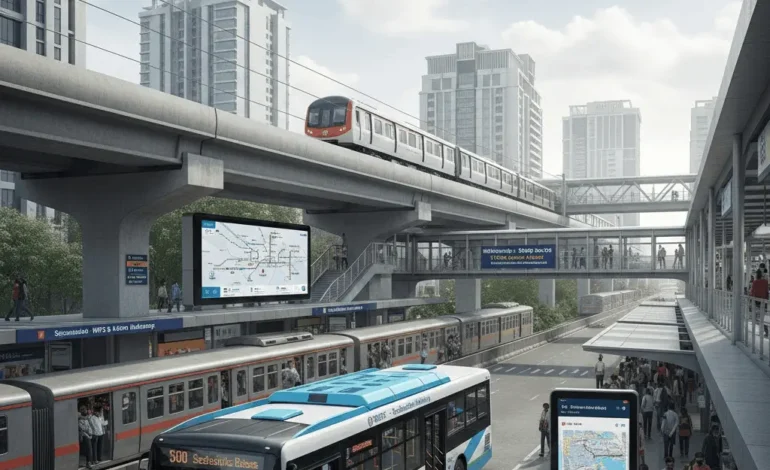
- Metro expansion project valued at ₹15,000 crore targeting 72 km connectivity
These systems focus on sustainability, efficiency, and urban mobility.
Surveillance, Traffic Management and Digital Infrastructure
The city has deployed:
- 10,000+ CCTV cameras integrated with Hawk Eye policing systems
- AI-based traffic monitoring and e-challan automation
- Public Wi-Fi infrastructure in commercial and tourist zones
- IoT-based waste bins and motion-sensor street lighting in growth corridors
Data analytics is increasingly used for:
- Traffic flow optimization
- Urban planning
- Resource allocation
Officials report measurable improvements in congestion management and operational efficiency.
Related article
1. Hyderabad Infrastructure 2026: RRR Phase 1 Near Completion as NH-44 Flyover Delays Frustrate Commuters
2. GHMC Budget 2024–25: What It Means for Hyderabad’s Growth
Multimodal Connectivity and Growth Corridors
Smart corridor development includes integration between:
- Hyderabad Metro
- Outer Ring Road (ORR)
- Regional Ring Road (RRR)
This multimodal strategy aims to reduce congestion, improve last-mile connectivity, and support expanding IT and residential clusters.
Green space development and water conservation projects are being scaled in parallel.
Telangana’s Future City Project – A Net-Zero Urban Model
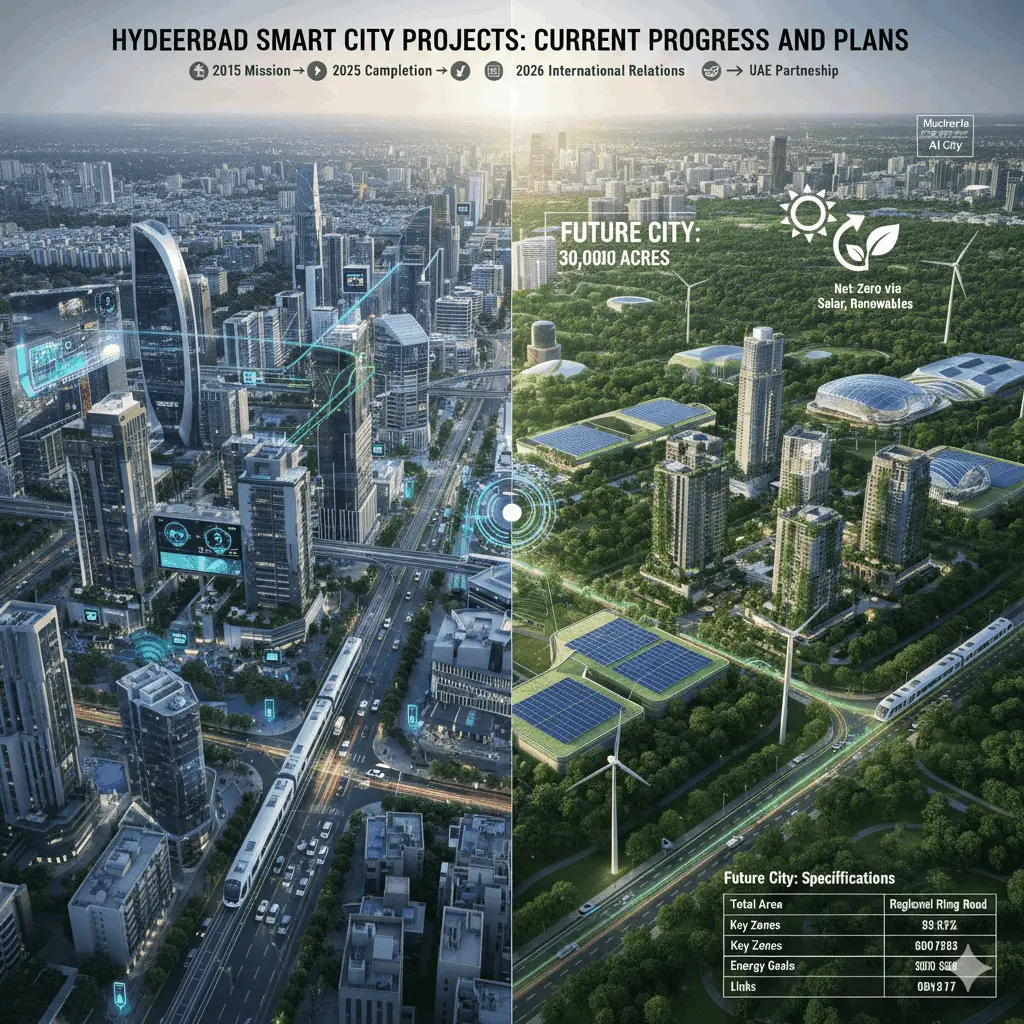
The Future City project, spanning approximately 30,000 acres along the Srisailam Highway, is being developed as a next-generation net-zero urban hub.
Future City Key Features
| Feature | Specification |
|---|---|
| Total Area | 30,000 acres |
| Core Zones | Residential, Industrial, Commercial, Green |
| Energy Model | Net-zero via solar and renewables |
| Connectivity | ORR, RRR, proposed metro links |
| Focus Sectors | AI, life sciences, fintech |
The project aims to promote zero-waste recycling, rainwater harvesting, and renewable energy systems.
Long-term economic projections align with Telangana’s 2047 development roadmap.
Emerging Developments – AI City and 15-Minute City Model
Additional proposals include:
- Mucherla AI City (Fourth City concept)
- 15-minute city design with radial road networks
- Net-zero pharma parks targeted by 2027
These developments are expected to stimulate real estate growth, employment generation, and IT-pharma sector expansion.
Challenges and Implementation Outlook
Despite significant progress, challenges remain:
- Budget constraints
- Project timeline extensions
- Post-pandemic execution delays
However, state-level prioritization and phased funding extensions indicate continued momentum.
Hyderabad’s smart infrastructure push positions the city as a technology-driven, sustainability-focused urban center.


2 Comments
[…] Hyderabad Smart City Projects 2026: Future City Vision, Net-Zero Targets & Infra Updates […]
[…] Hyderabad Smart City Projects 2026: Future City Vision, Net-Zero Targets & Infra Updates […]