

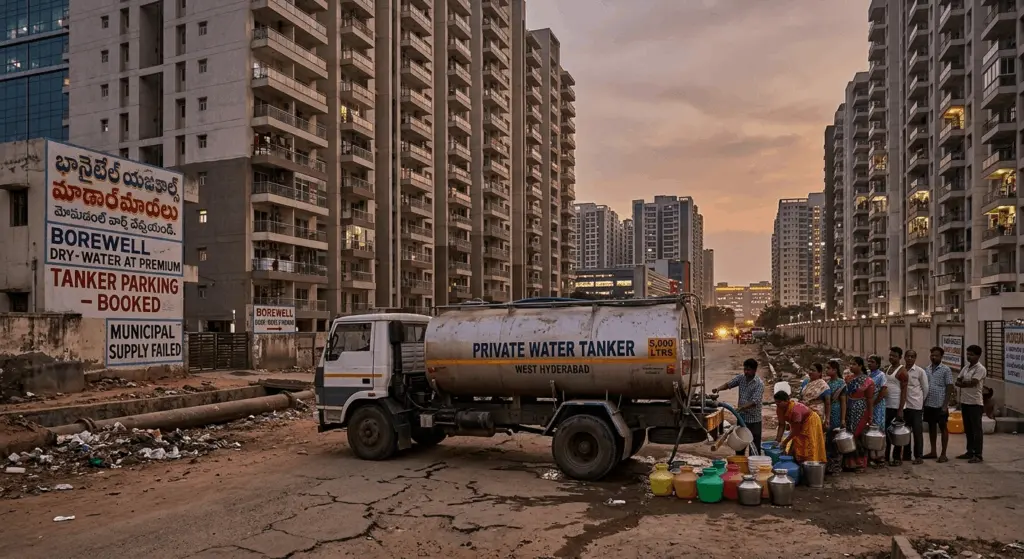
In the shadow of Hyderabad’s booming IT skyline and rapidly expanding residential towers, a quieter crisis is intensifying—water scarcity.
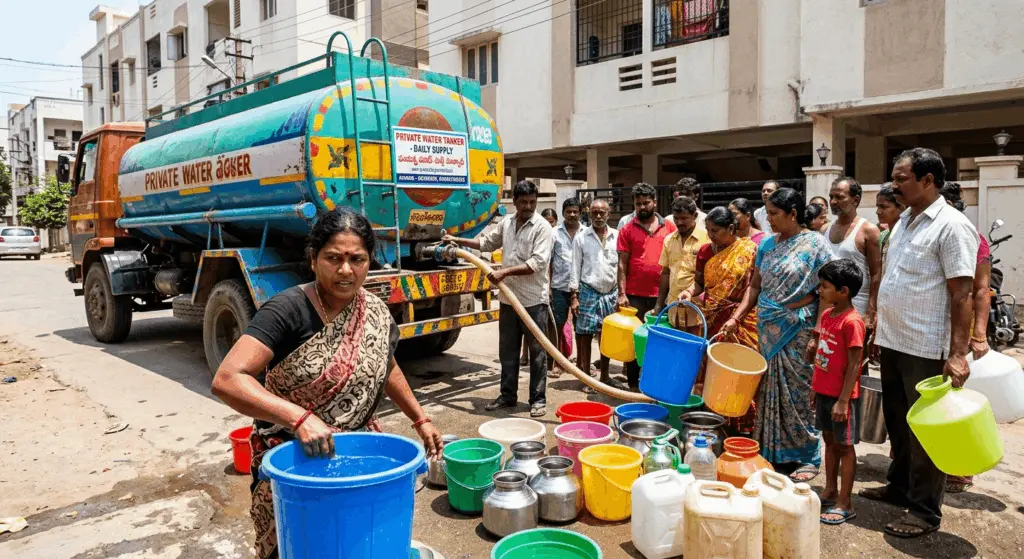
Across West Hyderabad, especially in areas like Gachibowli, Tellapur, Kokapet, Kondapur, and Manikonda, residents are increasingly dependent on private water tankers as borewells dry up and municipal supply struggles to meet demand.
What was once a seasonal inconvenience has now evolved into a permanent urban infrastructure problem, forcing thousands of households to treat water not as a utility—but as a premium monthly expense.
Related Post
Why Is Hyderabad’s Water Tanker Demand Rising?
The sharp increase in tanker demand is not simply due to low rainfall.
It is the result of three major urban failures:
- Rapid real estate growth without matching water infrastructure
- Falling groundwater levels
- Increasing dependence on private water suppliers
West Hyderabad, the city’s fastest-growing residential corridor, is feeling this pressure the most.
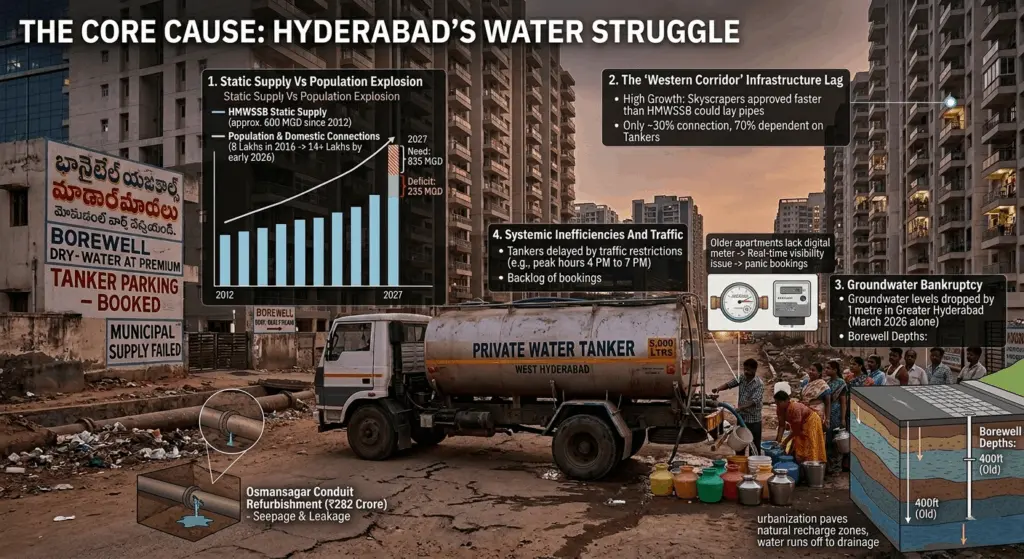
The Core Cause Behind Hyderabad’s Water Crisis
1. Population Growth Has Outpaced Water Supply
Hyderabad’s official water supply capacity has remained close to 600 Million Gallons per Day (MGD) for years.
However:
- Domestic water connections grew from 8 lakh in 2016 to over 14 lakh in 2026
- Demand now exceeds 700 MGD
- By 2027, experts estimate demand could reach 835 MGD
That creates a massive projected shortfall.
Simply put:
More people. Same supply. Bigger crisis.
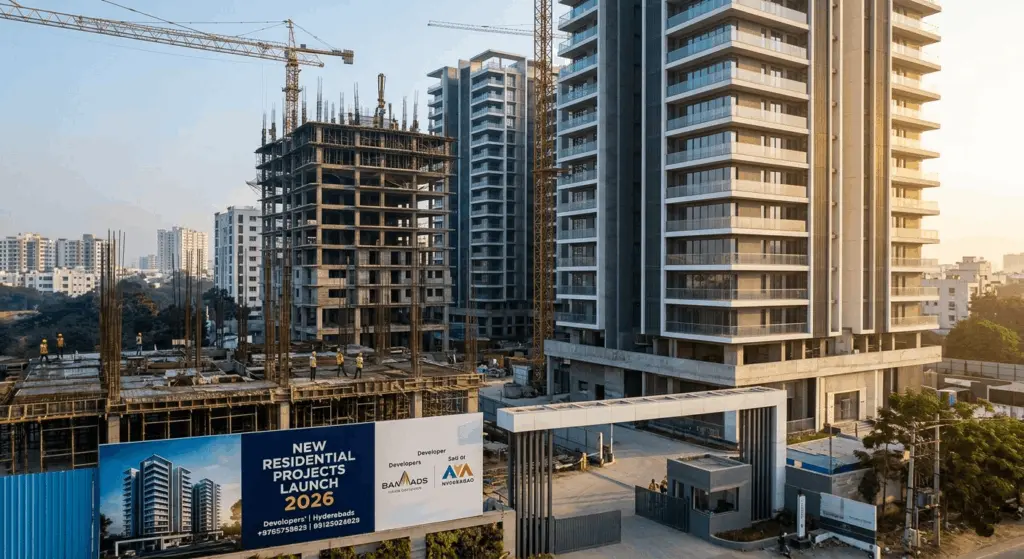
2. West Hyderabad Developed Faster Than Infrastructure
Areas like:
- Tellapur
- Kollur
- Kokapet
- Financial District
have witnessed explosive high-rise development.
Many towers were built before pipelines were installed properly.
Industry estimates suggest:
- Only around 30% of homes in some western pockets receive regular municipal water
- Nearly 70% depend on tankers
That makes private water the default—not backup.
3. Groundwater Levels Are Collapsing
This is the most dangerous long-term issue.
In 2026:
- Borewell levels dropped by nearly 1 meter in one month
- Older 400-foot borewells are now failing
- New borewells are being drilled at 1,500–2,000 feet
That is not sustainable.
Urban concrete expansion has also reduced natural recharge zones, meaning rainwater no longer seeps back underground effectively.
4. Traffic and Delivery Restrictions Make Things Worse
Even when residents book water:
delivery delays are common.
Why?
- Peak-hour tanker restrictions
- Traffic congestion
- Panic bookings from apartments
Result:
A “48-hour delivery promise” often becomes 3–5 days.
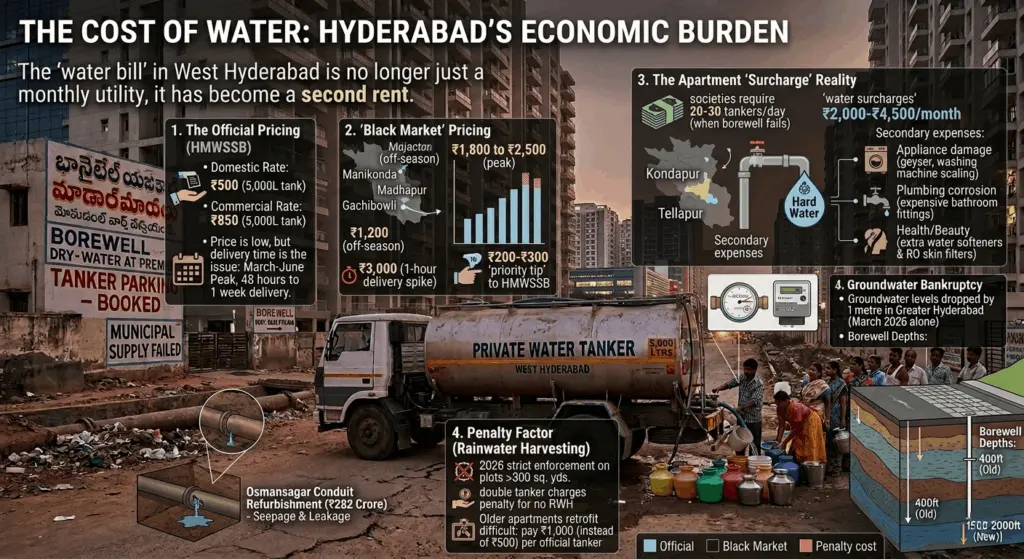
What Does Water Cost in Hyderabad Now?
For many residents, water has become a second rent.
Official HMWSSB Tanker Rates
Government prices remain subsidized:
- Domestic: ₹500 for 5,000 liters
- Commercial: ₹850 for 5,000 liters
Problem?
Availability.
Residents often wait days.
Private Tanker Market Rates
Private suppliers charge:
- Off-season: ₹1,200
- Summer: ₹1,800–₹2,500
- Emergency delivery: up to ₹3,000
That is 4–6x higher than government rates.
Apartment Maintenance Charges Are Rising
Large gated communities need:
- 20–30 tankers daily
That adds:
₹2,000–₹4,500 extra per month per family.
This hidden “water tax” is becoming normal.
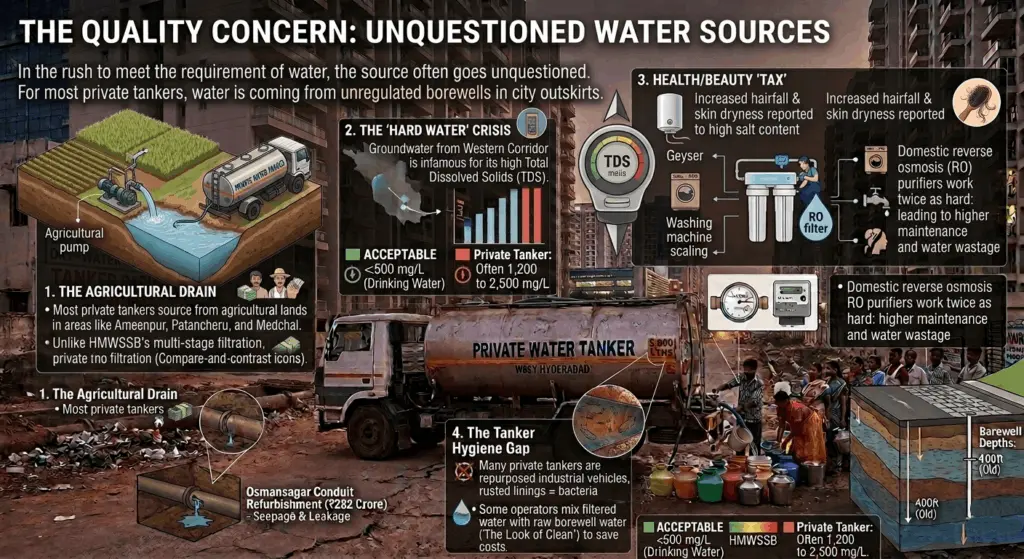
Water Quality Is Becoming a New Problem
Quantity isn’t the only issue.
Quality is increasingly questionable.
Unregulated Borewell Sources
Many private tankers source water from:
- Patancheru
- Medchal
- Ameenpur
This water often bypasses proper treatment.
Hard Water Damage
Private tanker water often has:
TDS levels between 1,200–2,500 mg/L
Recommended drinking level:
Below 500 mg/L
Effects include:
- Hair fall
- Skin dryness
- Appliance damage
- Pipe corrosion
Residents are now spending more on:
- RO systems
- Water softeners
- Repairs
Tanker Hygiene Concerns
Some operators use poorly maintained vehicles.
Risks include:
- bacterial contamination
- rust contamination
- mixed untreated water
This creates a public health concern.
Government Response – Is It Enough?
Authorities are taking steps.
Current Actions
- Osmansagar pipeline repair project
- New HMWSSB infrastructure expansion
- Rainwater harvesting penalties
- Pressure on apartments to install recharge systems
But experts say this is not enough.
The city needs:
- faster pipeline rollout
- mandatory rainwater harvesting
- stricter borewell regulation
- wastewater recycling
Without these reforms, tanker dependency will continue rising.
What Residents Can Do Right Now
Experts recommend:
Short-Term Steps
✔ Install water meters
✔ Monitor daily consumption
✔ Fix internal leakages
✔ Use dual-flush systems
Long-Term Steps
✔ Build rainwater harvesting pits
✔ Invest in STP systems in apartments
✔ Recharge borewells
✔ Demand better civic planning
Expert View
Urban planners warn that Hyderabad is entering a “water stress decade.”
If population growth continues without sustainable water planning, today’s tanker crisis could become tomorrow’s city-wide emergency.
Conclusion
Hyderabad’s private water tanker boom is not a business trend.
It is a warning sign.
The city’s western growth story—from Gachibowli to Tellapur—is now paying the price for unsustainable development.
Until groundwater is protected and infrastructure catches up, residents will continue paying more—for something as basic as water.
And in 2026, that may be Hyderabad’s most expensive utility.



Leave a Reply